Program words of wisdom:
"Meetings are events in which minutes are kept and hours are lost.................if nobody is assign to execute the activities"
_____________________________________________________________________________________
If a company's practises this kind of communication channel, the end result will be very strange. In a meeting room, team members should be present, everybody should be treated as equal and with equal respect.
Production Engineer to RFP/RFQ Executive:
"This is not possible. **Impossible**. It will involve design change and no body in our team knows the full design of the product. And above that nobody in our company knows the language in which this software has been written by another company. So even if somebody wants to work on it, they can't. If you ask my personal opinion the company should never take these type of business."
RFP/RFQ Executive to Program Manager:
"This Project will involve design change. Currently we don't have people who have experience in this type of work. Also the obsolete IC Chip replacement is unknown so we will have to arrange for some training if we take this business. In my personal opinion, we should avoid taking this Project."
Program Manager to Program Director:
"This Project involves design change in the system and we don't have much experience in that area. Also not many people are trained in this area. In my personal opinion we can take the business but we should ask for some more time to invest in a new Design Department and employ required expertise."
Program Director to Sales Vice President
"This Project involves design re-engineering. We have some people who have worked in this area and some who know the language. So they can train other people. In my personal opinion we should take this business but with caution."
Sales VP to CEO:
"This Project will show the industry our capabilities in remodeling the design of a complete system. We will have all the necessary skills and people to execute this Program successfully. Some people have already given in-house training in this area to other people. In my personal opinion we should not let this business go by under any circumstance."
CEO to Client:
"These are the type of Business in which our company specialize. We have executed many Projects of the same nature for many big clients. Trust me when I say that you are in the safest hand in the Industry. In my personal opinion we can execute this business successfully and that too well with in the given time frame."
Kacak5 Management
Friday, 25 September 2009


Living in 2009 and laughing
Business Management words of wisdom:-
Evolve with time or be a dinosaur.
I started working in the Program & Business Management environment since 1990 while we were still using faxes and transparencies. I had to carry very heavy luggage during any oversea business trips as the communications and files are in hardcopy papers with several transparencies for each company that I visited.
For those younger generations, faxes were received at a centralised fax machine for in-bound and outbound letters where an operator will be required to read the content. If the fax attentioned to me have 3 other names to be cc to, the operator will photocopy 3 sets and placed it into the respective pigeon hole for the respective department to collect. The amount of A4 papers used was fantastic and keeps piling up in my office as we have to file these hardcopy document.
Transparencies are A4 sized transparent plastic sheets used for placing our presentation materials which are later placed on a powerful light source that project the image/ information onto a screen.
We can travel very light now on a PC notebook.
YOU KNOW YOU ARE LIVING IN 2009 when...
1. You accidentally enter your password on the microwave. Password is also required for office photocopier machines nowadays.
2. You haven't played solitaire with real cards in years. In fact , many had been playing alone against the computers.
3. You have a list of 15 phone numbers to reach your family of 3, but you do not memories all the phone numbers.
4. You e-mail the person who works at the desk next to you. Skype chat or MSN Messager is the favorite here.
5. With web's help, you can communicate in any languages to the foreign person who sits at the desk next to you.
6. You pull up in your own driveway and use your cell phone to see if anyone is home to help you carry in the groceries. Door bells becomes obsolete.
7. Every commercial on television has a web site at the bottom of the screen. Any company that does not have website are fake.
8. Leaving the house without your cell phone, which you didn't have the first 20 or 30 (or 60) years of your life, is now a cause for panic and you turn around to go and get it.
10. You get up in the morning and go on line before getting your coffee. You have to go on line before going to sleep too.
11. You start tilting your head sideways to smile. : )
12. You're reading this and nodding and laughing.
13. Even worse, you know exactly how to write foul rude words without being foul like ^&#$%^&*+_)(*.
14. You are too busy to notice there was no #9 on this list.
15. Your reason for not staying in touch with friends and family is that they don't have e-mail addresses. Greetings cards are sent on softcopies only.
16. You actually scrolled back up to check that there wasn't a #9 on this list
AND NOW YOU ARE LAUGHING at yourself.
Kacak5 Management
Evolve with time or be a dinosaur.
I started working in the Program & Business Management environment since 1990 while we were still using faxes and transparencies. I had to carry very heavy luggage during any oversea business trips as the communications and files are in hardcopy papers with several transparencies for each company that I visited.
For those younger generations, faxes were received at a centralised fax machine for in-bound and outbound letters where an operator will be required to read the content. If the fax attentioned to me have 3 other names to be cc to, the operator will photocopy 3 sets and placed it into the respective pigeon hole for the respective department to collect. The amount of A4 papers used was fantastic and keeps piling up in my office as we have to file these hardcopy document.
Transparencies are A4 sized transparent plastic sheets used for placing our presentation materials which are later placed on a powerful light source that project the image/ information onto a screen.
We can travel very light now on a PC notebook.
YOU KNOW YOU ARE LIVING IN 2009 when...
1. You accidentally enter your password on the microwave. Password is also required for office photocopier machines nowadays.
2. You haven't played solitaire with real cards in years. In fact , many had been playing alone against the computers.
3. You have a list of 15 phone numbers to reach your family of 3, but you do not memories all the phone numbers.
4. You e-mail the person who works at the desk next to you. Skype chat or MSN Messager is the favorite here.
5. With web's help, you can communicate in any languages to the foreign person who sits at the desk next to you.
6. You pull up in your own driveway and use your cell phone to see if anyone is home to help you carry in the groceries. Door bells becomes obsolete.
7. Every commercial on television has a web site at the bottom of the screen. Any company that does not have website are fake.
8. Leaving the house without your cell phone, which you didn't have the first 20 or 30 (or 60) years of your life, is now a cause for panic and you turn around to go and get it.
10. You get up in the morning and go on line before getting your coffee. You have to go on line before going to sleep too.
11. You start tilting your head sideways to smile. : )
12. You're reading this and nodding and laughing.
13. Even worse, you know exactly how to write foul rude words without being foul like ^&#$%^&*+_)(*.
14. You are too busy to notice there was no #9 on this list.
15. Your reason for not staying in touch with friends and family is that they don't have e-mail addresses. Greetings cards are sent on softcopies only.
16. You actually scrolled back up to check that there wasn't a #9 on this list
AND NOW YOU ARE LAUGHING at yourself.
Kacak5 Management
Wednesday, 23 September 2009
Guide to EMS Outsourcing Management
Program words of wisdom:-
If Project/Program content is allowed to change freely the rate of change will exceed the rate of progress.
Manufacturing Agreements (MA) are legally binding agreements between two or more parties. MA are pervasive and used in many aspects of life such as they form the cornerstone of commerce in the modern economy. Outsourcing terms are enforceable by the legal system and courts of any modern state. Effective outsourcing management before the MA is an important function in many businesses.
Outsourcing Process
There are four stages in the outsourcing process:
1) Requisition process: Internally at this stage, specifications of the work are determined, and qualified manufacturers are identified.
2) Solicitation process: This entails asking for bids or proposals. Various EMS or service providers will be asked to participate in this process. When purchasing commodities, price might be the deciding factor, but when buying a specific service or product various factors such as competence, quality and warranties are taken into account in accepting a bid or proposal.
3) Award process: At this stage, a manufacturer is selected and a MA contract is negotiated and signed.
4) Manufacturing process: Finally the manufacturing is actually carried out. The manufacturer and purchaser follow the terms of the MA, organize the work and monitor progress.
Some common types of MA are as follows:
1) Fixed price or lump sum: In this type of contract there is an agreed price for the performance of work. It provides a degree of certainty for both parties because the MA clearly defines what is involved and at what price.
2) Unit rate: Here the pay is directly proportional to the volume and range of work. An example is supply of electronics products where the monetary amount would be defined by the volume of units supplied.
3) Reimbursable or cost plus: There is an upfront payment to the manufacturer. These types of agreement are used when the scope of the work is a one off activity like Non Recurring Expenses for tooling, jigs and fixtures.
4) Project/program management: Here the manufacturer agrees to manage a turnkey project for a specific duration of time, from ground zero blank sheet of paper to actual realisation of the final box build product.
Structure
Generally a MA should contain the following headings:
1) Definition of MA terms: This section defined terms and field-specific word.
2) Project scope: This section provides information on the whole project to give context to the services that the MA is going to provide.
3) The services and work to be performed.
4) Facilities that should be provided by the client (e.g. testers, tooling....).
5) Warranties and guarantees of the services provided.
6) Definition of fee base i.e. cost of the project.
7) Terms of payment: Time of payments and conditions that should be met for the payment are clarified.
8) Taxes (e.g. sales and use tax).
9) Insurance coverage and freight terms
10) Other contractual provisions based on the nature of the program.
11) Miscellaneous provisions like "excess material liability should the program ends"
Kacak5 Management
If Project/Program content is allowed to change freely the rate of change will exceed the rate of progress.
Manufacturing Agreements (MA) are legally binding agreements between two or more parties. MA are pervasive and used in many aspects of life such as they form the cornerstone of commerce in the modern economy. Outsourcing terms are enforceable by the legal system and courts of any modern state. Effective outsourcing management before the MA is an important function in many businesses.
Outsourcing Process
There are four stages in the outsourcing process:
1) Requisition process: Internally at this stage, specifications of the work are determined, and qualified manufacturers are identified.
2) Solicitation process: This entails asking for bids or proposals. Various EMS or service providers will be asked to participate in this process. When purchasing commodities, price might be the deciding factor, but when buying a specific service or product various factors such as competence, quality and warranties are taken into account in accepting a bid or proposal.
3) Award process: At this stage, a manufacturer is selected and a MA contract is negotiated and signed.
4) Manufacturing process: Finally the manufacturing is actually carried out. The manufacturer and purchaser follow the terms of the MA, organize the work and monitor progress.
Some common types of MA are as follows:
1) Fixed price or lump sum: In this type of contract there is an agreed price for the performance of work. It provides a degree of certainty for both parties because the MA clearly defines what is involved and at what price.
2) Unit rate: Here the pay is directly proportional to the volume and range of work. An example is supply of electronics products where the monetary amount would be defined by the volume of units supplied.
3) Reimbursable or cost plus: There is an upfront payment to the manufacturer. These types of agreement are used when the scope of the work is a one off activity like Non Recurring Expenses for tooling, jigs and fixtures.
4) Project/program management: Here the manufacturer agrees to manage a turnkey project for a specific duration of time, from ground zero blank sheet of paper to actual realisation of the final box build product.
Structure
Generally a MA should contain the following headings:
1) Definition of MA terms: This section defined terms and field-specific word.
2) Project scope: This section provides information on the whole project to give context to the services that the MA is going to provide.
3) The services and work to be performed.
4) Facilities that should be provided by the client (e.g. testers, tooling....).
5) Warranties and guarantees of the services provided.
6) Definition of fee base i.e. cost of the project.
7) Terms of payment: Time of payments and conditions that should be met for the payment are clarified.
8) Taxes (e.g. sales and use tax).
9) Insurance coverage and freight terms
10) Other contractual provisions based on the nature of the program.
11) Miscellaneous provisions like "excess material liability should the program ends"
Kacak5 Management
Monday, 21 September 2009
Humor for Program Managers
Program words of wisdom:-
Program Managers ability to reason through many different manufacturing & business issues was aided by the ability to relax under pressure and see the lighter side of life.
Humor can change the attitude of individuals and provide a healthy, productive atmosphere when used properly. Business situations, however, often lend themselves to humor that changes the way a person looks at the environment.
Humor in the work place can improve the efficiency and effectiveness of a program/business team when used appropriately and people can laugh at themselves. Humor can be used to defuse tense situations and to suggest correction to behavior that is counter to the team’s goals. Demeaning or vicious humor can, however, destroy the unity of a team and isolate individuals because of perceived criticism.
During a Business trip to China, one Chinese man humor to question the credentials of a woman in the company because of the manner in which she was conducting herself.
He stated, “Her resume says ‘doctor of philosophy,’ I think there is a mistake.”
I responded to the statement, “No, she has a Ph.D. in management science.”
The Chinese interpreter came back with the statement, “Oh no, I think that she is doctor of complexity.”
Of course we laughed, which meant that I agreed with him. Through humor, the Chinese interpreter and I had achieved a common understanding to criticize about this person’s competence.
Humor plays an important role in getting team members to relax and not dwell on the negative side of management challenges. A team member cannot laugh and still be angry or have negative feelings about what is happening. Obtaining a laugh should be a goal to change how a situation looks.
The Chinese are masters at criticism with humor, which causes the person to recognize the bad situation without losing face. In all cultures, perhaps, humor at the right time and right place can lead to better relationships among team members as long as the humor is not demeaning or off color.
Properly used humor can build on relationships in programs, smooth over rough edges, and promote productivity. The wrong type of humor, however, can work to the detriment of the project/program team by isolating an individual through criticism. Humor should not be used as a substitute for coaching or mentoring, but as a way of getting individuals to look at challenges through a different prism.
Kacak5 Management
Program Managers ability to reason through many different manufacturing & business issues was aided by the ability to relax under pressure and see the lighter side of life.
Humor can change the attitude of individuals and provide a healthy, productive atmosphere when used properly. Business situations, however, often lend themselves to humor that changes the way a person looks at the environment.
Humor in the work place can improve the efficiency and effectiveness of a program/business team when used appropriately and people can laugh at themselves. Humor can be used to defuse tense situations and to suggest correction to behavior that is counter to the team’s goals. Demeaning or vicious humor can, however, destroy the unity of a team and isolate individuals because of perceived criticism.
During a Business trip to China, one Chinese man humor to question the credentials of a woman in the company because of the manner in which she was conducting herself.
He stated, “Her resume says ‘doctor of philosophy,’ I think there is a mistake.”
I responded to the statement, “No, she has a Ph.D. in management science.”
The Chinese interpreter came back with the statement, “Oh no, I think that she is doctor of complexity.”
Of course we laughed, which meant that I agreed with him. Through humor, the Chinese interpreter and I had achieved a common understanding to criticize about this person’s competence.
Humor plays an important role in getting team members to relax and not dwell on the negative side of management challenges. A team member cannot laugh and still be angry or have negative feelings about what is happening. Obtaining a laugh should be a goal to change how a situation looks.
The Chinese are masters at criticism with humor, which causes the person to recognize the bad situation without losing face. In all cultures, perhaps, humor at the right time and right place can lead to better relationships among team members as long as the humor is not demeaning or off color.
Properly used humor can build on relationships in programs, smooth over rough edges, and promote productivity. The wrong type of humor, however, can work to the detriment of the project/program team by isolating an individual through criticism. Humor should not be used as a substitute for coaching or mentoring, but as a way of getting individuals to look at challenges through a different prism.
Kacak5 Management
Friday, 18 September 2009
10 Ways Program Management Change Your World
Program words of wisdom:-
"Good Program Managers know when not to manage a Program.
If there were no problem people there'd be no need for people who solve problems".
_________________________________________________________________
1. Set a personal and an organizational vision for long-term sustainable success because we tend to create what we focus on. Focus on failure, and that is what we will get. Focus on people, and even in turbulent times, we have a better chance of being able to make a huge difference.
2. Create our own "school" of what it is we need and want to learn so we can be and become an effective contributor to other people and to our organization's success. Seek out opportunities to do our own formal and informal learning. For example, you can take the Project Management Professional study.
3. Develop a “can do, we will prevail” attitude, and bring those around us up with our thirst for knowledge and your enviable Program Management capabilities.
4. Join the Program or Project Management Institute as an individual and as a corporate member. Participating in this professional trade association helps both individuals and corporations better self-identify with doing good Program Management and that, in and of itself, can become a self-fulfilling prophecy.
5. Diversify and don't put all our eggs in one basket. This is true whether we are an individual relying on one industry or one company to meet all our financial needs or whether we are an organization that relies on one customer, or one product, to sustain our economic well-being.
6. Develop a safety net that will let us take appropriate risks in our career, and in our projects, so that we can weather whatever comes along. It’s just like the flight attendants tell us on their pre-flight safety instructions: "You need to secure your own mask before helping others".
7. Don't fall prey to those around us (and especially the media) with “the sky is falling” mentality. Do a risk management reality check on our projects and current events to develop our own risk management plan to handle the legitimate risks facing our life and our programs.
8. Create a change management plan for our life. When new opportunities arise (and sometimes these come disguised as difficulties), assess how these will impact us achieving our overall goals, and develop a strategy that incorporates change into our reality.
9. Drop commitments that are no longer serving us. We need to “cut bait” on the programs and commitments that are like the infamous bridge to nowhere. Look at these programs that are going nowhere and ask yourself, “If I had to make the decision today to start this project, would I?” If the answer is no, stop wasting our valuable resources on it.
10. Find the path of least resistance where we can make the biggest contribution for the least amount of effort. Every individual and organization has unique talents that when used effectively, in the right environments, can have significant impact. If something has become too
hard for us to do, maybe, just maybe, we should not be doing it. Seek out other opportunities where we can have more fun and make more of a difference. My personal motto is "What is meant to be, happens easily."
So, don’t buy into the Doomsday mentality. Use our Program Management skills to
make our own world and to make the most of every project, every day. It’s our time
to take center stage and be at the forefront of meeting the challenges in our life, at
work, at home or wherever we may find them.
Kacak5 Management
"Good Program Managers know when not to manage a Program.
If there were no problem people there'd be no need for people who solve problems".
_________________________________________________________________
1. Set a personal and an organizational vision for long-term sustainable success because we tend to create what we focus on. Focus on failure, and that is what we will get. Focus on people, and even in turbulent times, we have a better chance of being able to make a huge difference.
2. Create our own "school" of what it is we need and want to learn so we can be and become an effective contributor to other people and to our organization's success. Seek out opportunities to do our own formal and informal learning. For example, you can take the Project Management Professional study.
3. Develop a “can do, we will prevail” attitude, and bring those around us up with our thirst for knowledge and your enviable Program Management capabilities.
4. Join the Program or Project Management Institute as an individual and as a corporate member. Participating in this professional trade association helps both individuals and corporations better self-identify with doing good Program Management and that, in and of itself, can become a self-fulfilling prophecy.
5. Diversify and don't put all our eggs in one basket. This is true whether we are an individual relying on one industry or one company to meet all our financial needs or whether we are an organization that relies on one customer, or one product, to sustain our economic well-being.
6. Develop a safety net that will let us take appropriate risks in our career, and in our projects, so that we can weather whatever comes along. It’s just like the flight attendants tell us on their pre-flight safety instructions: "You need to secure your own mask before helping others".
7. Don't fall prey to those around us (and especially the media) with “the sky is falling” mentality. Do a risk management reality check on our projects and current events to develop our own risk management plan to handle the legitimate risks facing our life and our programs.
8. Create a change management plan for our life. When new opportunities arise (and sometimes these come disguised as difficulties), assess how these will impact us achieving our overall goals, and develop a strategy that incorporates change into our reality.
9. Drop commitments that are no longer serving us. We need to “cut bait” on the programs and commitments that are like the infamous bridge to nowhere. Look at these programs that are going nowhere and ask yourself, “If I had to make the decision today to start this project, would I?” If the answer is no, stop wasting our valuable resources on it.
10. Find the path of least resistance where we can make the biggest contribution for the least amount of effort. Every individual and organization has unique talents that when used effectively, in the right environments, can have significant impact. If something has become too
hard for us to do, maybe, just maybe, we should not be doing it. Seek out other opportunities where we can have more fun and make more of a difference. My personal motto is "What is meant to be, happens easily."
So, don’t buy into the Doomsday mentality. Use our Program Management skills to
make our own world and to make the most of every project, every day. It’s our time
to take center stage and be at the forefront of meeting the challenges in our life, at
work, at home or wherever we may find them.
Kacak5 Management
Wednesday, 16 September 2009
Genesis of Failure
Program words of wisdom:
_______________________________________________________________________________
Often times I was ask how this happen, and it's a very long story. For a child, we may start as "Once upon a time.....". To a working adult, we need another approach in the adult way. This is the consequence if there are communication roadblocks where we are strictly allow to communicate to our immediate superior only in the heirarchy.
In the beginning was THE PLAN.
And then came The Assumptions.
And The Plan was without substance.
And The Assumptions were without form.
And darkness was upon the face of the Workers.
And they spoke among themselves, saying,
"It is a crock of S H - T, it stinks."
And the workers went unto their Supervisors, and said,
"It is a pail of dung, and none may abide the odor thereof."
And the Supervisors went unto their Managers, saying
"It is a container of excrement, and it is very strong,
such that none may abide it."
And the Managers went unto their Directors, saying,
"It is a vessel of fertilizer, and none may abide its strength."
And the Directors spoke among themselves saying one to another, we have to clue-in nice words.
"It contains that which aids plant growth, and it is very strong."
And the Directors went to the Vice-Presidents, saying unto them,
"It promotes growth, and it is very powerful."
And the Sales Vice-Presidents went to the President, saying unto him,
"This new plan will actively promote the growth and vigor of the company, with powerful effects."
And the President looked upon The Plan, and saw that it was good.
And The Plan became POLICY.
And that is how S - - T happens."
Kacak5 Management
"If it looks like a duck, walks like a duck and quacks like a duck, it probably is a duck".
_______________________________________________________________________________
Often times I was ask how this happen, and it's a very long story. For a child, we may start as "Once upon a time.....". To a working adult, we need another approach in the adult way. This is the consequence if there are communication roadblocks where we are strictly allow to communicate to our immediate superior only in the heirarchy.
In the beginning was THE PLAN.
And then came The Assumptions.
And The Plan was without substance.
And The Assumptions were without form.
And darkness was upon the face of the Workers.
And they spoke among themselves, saying,
"It is a crock of S H - T, it stinks."
And the workers went unto their Supervisors, and said,
"It is a pail of dung, and none may abide the odor thereof."
And the Supervisors went unto their Managers, saying
"It is a container of excrement, and it is very strong,
such that none may abide it."
And the Managers went unto their Directors, saying,
"It is a vessel of fertilizer, and none may abide its strength."
And the Directors spoke among themselves saying one to another, we have to clue-in nice words.
"It contains that which aids plant growth, and it is very strong."
And the Directors went to the Vice-Presidents, saying unto them,
"It promotes growth, and it is very powerful."
And the Sales Vice-Presidents went to the President, saying unto him,
"This new plan will actively promote the growth and vigor of the company, with powerful effects."
And the President looked upon The Plan, and saw that it was good.
And The Plan became POLICY.
And that is how S - - T happens."
Kacak5 Management
Sunday, 13 September 2009
Contract Negotiation & Tactics for Program Managers
Program Management words of wisdom:
"A verbal contract isn't worth the evidence it's written on".
____________________________________________________________________
"A verbal contract isn't worth the evidence it's written on".
____________________________________________________________________
In any relationship, business, or daily live we does negotiation. That includes buying food as we want the best, fastest & cheapest. Though I was an Engineering graduate, I had once worked for an Electronics Manufacturing company that assigned me to screen all the company's contracts and agreement for its main essence and facts in protecting the company's interest. This also requires close collaboration with the Drew & Napier law firm to review its legality and verbiages.
3 main things to achieve are as follows
1. Buyer and seller come to agreement
2. Develop good relationship with seller
3. Negotiate items can include:
a) Fair and reasonable price
b) responsibilities and authority
c) technical and management approaches
d) contract financing
e) schedule and payment plans.
To achieve the above objective, often time either one of negotiation tactics are deployed
a) Deadline: Imposing deadline to reach agreement
b) Surprise: Surprising the other party with new information
c) Limited authority: Claiming inability to decide
d) Strategic delays: Request for a recess to divert attention
e) Missing man: Claiming that the right person is not available
f) Fait accompli: Claiming that a topic of dispute has already been decided and is no longer an issue.
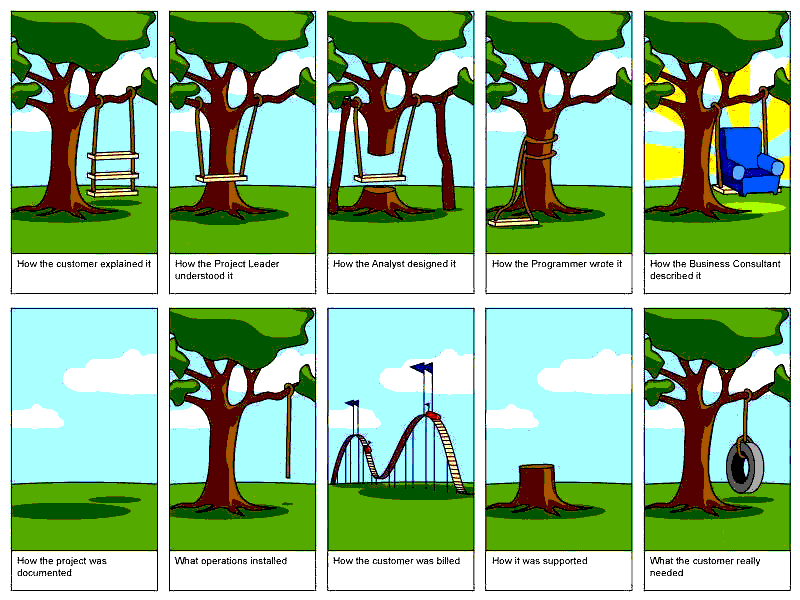
Please click this to see how we understand is often much different to what a customer needed.
Kacak5 Management.
Friday, 11 September 2009
Program manager desirable qualities and traits
Leadership
Program managers should be able to communicate complex issues and help gain consensus through the various levels of organizations, whether internally or externally, in order to accomplish what needs be done.
Industry experience
Program managers should have experience working with OEM-contract manufacturing relationships. The program manager must understand OEM customer-related demands and have a keen sense for urgency.
Ability to read engineering schematics
Program managers should be able to read engineering drawings, technical documents, and schematics and, should be able to relate any important changes to engineering and other functional groups.
Materials and supply chain understanding
Program managers should understand how materials demand is driven; organized, and the systematic management of materials...relative to manufacturing. Understanding of supply chain manufacturing concepts; materials and enterprise resources planning, vendor-managed inventory (VMI) systems and, regional hub distributions is also important.
Conflict resolution capabilities
Program managers are the central focal point between the contract manufacturer and the OEM and program managers often find themselves as mediators, in between different functional groups. Program managers should be able to handle conflict. Understanding how to balance multiple customer demands, with multiple personalities, for multiple OEM customer programs can be complex and conflicts will surface.
'How' conflict is handled is extremely important to the health of the OEM and contract manufacturing relationship. And, with conflict comes criticism...program managers are most effective when they are able to not take criticism personally.
KACAK5 Management
Subscribe to:
Posts (Atom)